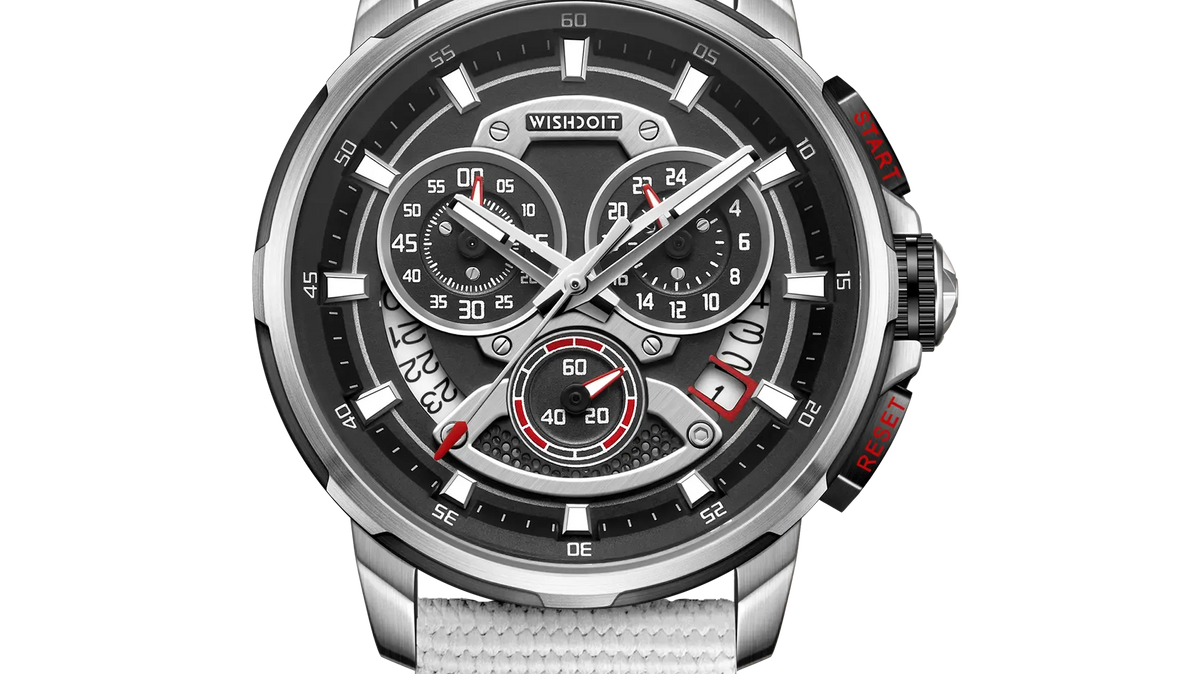
RACING GT 2.0 Chronograph Watch
$229.00

If you have ever caught yourself staring at a watch more than glancing at the time, a skeleton watch is probably speaking your language. Instead of a solid dial that hides everything underneath, an open or cut-away face lets you see bridges, gears, and the balance wheel at work. That open look is what people mean by an open-work (or open-worked) dial—and once you notice it, it is hard to go back to a closed face that keeps all the action secret.
This guide walks through what a skeleton watch is, how open-work dials and movements work day to day, what to expect for readability and care, and who these pieces tend to suit. When you want to line up real examples, browse the Wishdoit skeleton watches collection with the notes below in mind.

In friendly terms: a skeleton watch invites you inside. Dial material is removed or pierced so the movement becomes part of the design. You might spot the gear train, the bridges that hold it, screws catching the light, and that little balance wheel humming away. Some models open the dial almost fully; others keep a few plates or indexes for contrast. Either way, the mechanism is the show—not something buried under a closed face.
Skeletonization is mainly a design approach, not a separate “function” like a chronograph or GMT. Our overview of watch complications made simple puts skeleton dials in that context: they change how the watch looks and feels to own more than how many jobs it does.
Most people searching for a skeleton watch want a mechanical piece—especially an automatic skeleton watch—because a spinning rotor and a sweeping seconds hand reward an open dial. Quartz skeletons exist, but the visual payoff is usually quieter. Still choosing between power sources? Start with mechanical vs. quartz watches.
Behind every skeleton dial sits the same basic job as any mechanical watch: store energy, release it in steady beats, and drive the hands. What changes is how much of that architecture you get to watch while you wear it.

An automatic skeleton watch winds itself as you move. A rotor turns with wrist motion and tops up the mainspring. On an open dial, that motion—and the gear work beneath—becomes part of daily wear. Leave the watch unused long enough for its power reserve to run down and it simply stops; winding and setting it again is normal ownership, not a flaw. Follow the product instructions for crown position and winding direction.
Power reserve differs by movement, so always double-check the product page. Across Wishdoit’s tonneau skeletons, Aerial Prism is listed around ~48 hours, Full Speed around ~42 hours, and The Runway, Armor, The Pioneer, and Snow Leopard around ~80 hours. The movements are automatic mechanical with 21 jewels; most beat at 28,800 vph, while Full Speed is listed at 21,600 vph.
Hand-wound skeletons skip the automatic rotor and rely on crown winding. They can look especially open because nothing covers part of the movement. Wishdoit’s current tonneau skeleton lineup focuses on automatic movements; the care habits below still apply whenever a mainspring is involved.
Useful landmarks on an open dial include the bridges that hold the gear train, the balance that regulates timing, and finishing contrasts you can see in person—brushed next to polished edges, screws catching light, metalwork that shifts as your wrist turns. Named finishing techniques are not claimed here; the joy is simply seeing the architecture for yourself.
That is where design intent shows up. The Aerial Prism automatic mechanical skeleton leans into geometric, flight-inspired open architecture—light and shadow move across the cut-outs as you wear it. Armor builds a multilayer narrative and figurative statement over the open movement, so the skeleton feel comes with a bolder story on top.
Honest question every buyer asks: is a skeleton watch harder to read? It can be—if the hands vanish into a busy background. It does not have to be.

When you shop, keep three practical cues in mind:
The Runway skeleton tonneau pairs luminous hands and markers with an open dial so night readability stays practical. When you evaluate photos, look at the hands first, then the movement—if the time takes more than a second to find, keep comparing layouts.
Open dials get the attention, but the case, crystal, and strap are what you live with every day. Across Aerial Prism, The Runway, Armor, Full Speed, The Pioneer, and Snow Leopard, the shared craft story on the product pages looks like this:
An open dial does not mean the movement is unprotected. The crystal, case, and seals still form the primary barrier. Wipe the crystal and case with a soft cloth; skip household cleaners and abrasives. Respect the 5 ATM rating—do not operate the crown while wet, and have seals checked after a hard knock or before any water exposure after service. Ease the watch through strong shocks, magnets, heavy gym work, and tools. Mechanical watches need periodic cleaning and lubrication as oils age; between services, regular wear (or occasional winding) keeps the automatic happier than long storage stopped.
Wishdoit often pairs skeleton dials with a tonneau skeleton watch case—the barrel-inspired outline that is longer from 12 to 6 than a round watch of similar width. That taller window frames bridges and layered dials cleanly, so open-work reads as architecture rather than a small round porthole.
Most of the men’s examples here share that familiar sport footprint: about 42 mm × 50 mm, roughly 14.8 mm thick, with fluorine rubber straps around 25 mm wide. Weight still differs by model—compare listed grams if comfort is a priority. For shape, fit, and who tonneau suits in general, see our pillar on what a tonneau watch is, and use the watch sizing guide before you decide on length and overhang.

A skeleton watch often suits you if you enjoy seeing mechanics in motion, want a conversation-ready dial that still tells time, like architectural or motorsport-leaning design, or want a first mechanical watch that feels interactive rather than invisible.
Compare carefully if you need the absolute simplest glance readability in every lighting condition, prefer a quiet minimal dress watch, or want zero ownership ritual. In those cases, a solid-dial quartz or a cleaner automatic may fit better—our first-watch guide maps those trade-offs without pressure.
Within Wishdoit’s open-work range, personality differs even when case size looks similar. Think of each model’s design intent as a different reason the dial is open:
Collectors often rotate several skeletons for mood; first-mechanical buyers usually do better picking one layout they can read confidently, then learning winding and power-reserve habits over a few weeks of regular wear.

A skeleton watch uses an open-work dial (and sometimes an open caseback) so you can see parts of the movement—bridges, gears, and the balance—while the watch still tells time. It is a design choice that makes the mechanism part of the look.
Neither is universally better. An automatic skeleton watch rewards you with visible mechanical motion and no battery, but it needs regular wear or winding and eventual mechanical service. A quartz skeleton is usually lower-maintenance and more accurate on paper, with a quieter visual “engine.” Choose based on whether you want interaction or grab-and-go convenience.
They can be if hands blend into the movement. Good designs keep strong hand contrast, clear markers, and useful lume—The Runway’s luminous hands and markers are a practical example. Study wrist photos and ask whether you can read the time in one glance before you buy.
Keep the sapphire-coated mineral crystal clean with a soft cloth, respect the 5 ATM rating on the product page (everyday splash, not swimming or diving), avoid strong impacts and magnets, and plan for periodic professional service like any mechanical watch.
A tonneau skeleton watch pairs an open-work dial with a barrel-shaped case that is longer top-to-bottom than a round watch of similar width. Wishdoit’s tonneau skeletons—such as Aerial Prism, Full Speed, The Pioneer, The Runway, Armor, and Snow Leopard—use that shape as a signature, typically in 316L stainless steel around 42 × 50 × 14.8 mm with fluorine rubber straps. For case fit details, read the tonneau watch guide and compare specs in the tonneau collection.
A skeleton watch is for people who want the mechanism in the story—not hidden behind a closed dial. Once you understand open-work design, the materials that back it up, readability cues, calm care habits, and whether a tonneau frame fits your wrist, choosing an automatic skeleton becomes a matter of taste and routine rather than guesswork.
When you are ready to compare layouts side by side, explore the skeleton watches collection and match each model’s published specs—and dial photos—to how you actually wear a watch.